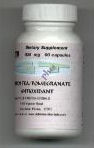
 GT
plus GT
plus
mfg for and distributed by OTH
-
300 mg Standardized Green Tea
Extract...over 60% polyphenols!!!
-
100 mg Powdered Green Tea Leaf
-
125 mg Pomegranate Extract... 40%
Ellagic Acid
-
POMEGRANATE EXTRACT 40%
POWERFUL ANTIOXIDANT THAT
COMBINES
EXTRACTS OF GREEN TEA & POMEGRANATE
SATISFACTION GUARANTEED OR A FULL
REFUND!!!!!!!!!
The lovely and delicious pomegranate
fruit reminds us of the lush gardens of Andalucia,
Spain. The name comes from Pomme de Granada, "apple of
Granada" it was thought to have originated there.
Granada's coat-of-arms still displays the picture of
this exotic fruit. In ancient times, pomegranate fruit
was regarded as a symbol of fertility due to the round
shape, and abundant seeds. Recently however, science has
discovered important compounds, which indicate its
benefits, transcend ancient symbolism.
Pomegranate
extract is primarily composed of alkaloids and
polyphenols. The active constituent that appears to be
responsible for its multiple health benefits is
Ellagic acid. Ellagic
acid is a naturally occurring phenolic compound found in
several fruits and nuts. Pomegranate extract has
demonstrated a variety of beneficial functions including
antioxidant and anti-viral activity. In 1996, a
Nottingham, PA University research team learned that
pomegranate extract could destroy several viruses nearly
on contact. The discovery of this anti-viral activity
instigated further experimentation and clinical trials.
One study confirmed that Ellagic acid effectively
protects cells from damaging free radicals. Additional
phenolic compounds found in pomegranate known as
anthocynadins (also well known scavengers of free
radicals) combine synergistically with Ellagic acid to
greatly augment pomegranate's potency as an antioxidant.
Of great importance is the
pomegranate extracts potential use as a chemo-preventive
agent. Initial experimentation by Stoner and Mukhtar
showed that Ellagic acid decreased the number of
chemically induced lung tumors by 44-75%. Mukhtar
further illustrated that topical application of Ellagic
acid provided protection against chemically induced skin
tumors.
Ellagic acid has several mechanisms of actions by which
it exhibits its chemo-preventive properties. Research by
Barch et al. Demonstrated that Ellagic acid could
actually bind to DNA, thus preventing its carcinogenic
alteration. Additionally, Ellagic acid has been shown to
induce the production of phase 11 detoxification enzymes
through its manipulation of gene expression. With an
increased concentration of these enzymes, various
tissues ability to detoxify harmful compounds is
augmented. Finally, Ellagic acid was found to be a
potent inhibitor of tyrosine protein kinase, a molecule
whose activity has been associated with the ability of
certain viruses to transform normal cells into cancerous
cells.
Active
Compounds:
Green tea contains volatile oils, vitamins, minerals,
and caffeine, but the active constituents are
polyphenols, particularly the catechin called
epigallocatechin gallate (EGCG). The polyphenols are
believed to be responsible for most of green tea's roles
in promoting good health.
Research demonstrates that green tea guards against
cardiovascular disease in many ways. Green tea lowers
total cholesterol levels and improves the cholesterol
profile (the ratio of LDL cholesterol to HDL
cholesterol), reduces platelet aggregation, and lowers
blood pressure.
The polyphenols in green tea have also been shown to
lessen the risk of several types of cancers, stimulate
the production of several immune system cells, and have
antibacterial properties-even against the bacteria that
cause dental plaque.
History:
According to Chinese legend, tea was discovered
accidentally by an emperor 4,000 years ago. Since then,
traditional Chinese medicine has recommended green tea
for headaches, body aches and pains, digestion,
depression, immune enhancement, detoxification, as an
energizer, and to prolong life. Modern research has
confirmed many of these health benefits.
Remedies
For: Green tea is useful for:
Cancer risk reduction
-
Gingivitis (periodontal disease)
-
High cholesterol
-
Hypertension (high blood pressure)
-
Hypertriglyceridemia (high
triglycerides)
-
Immune function
-
Infection
Most of the studies of the effect of the green tea have
been focused on its cancer-causing and cancer-protecting
aspects. Green tea polyphenols are potent antioxidant
compounds. They are more potent antioxidants than
vitamin E and vitamin C.
Green tea may also increase the activity of the
antioxidant enzyme. A number of animal studies have
shown that green tea polyphenols may offer significant
protection from cancer. It is believed that they do so
by blocking the formation of cancer-causing compounds
such as nitrosamines, suppressing the activation of
carcinogens, and detoxifying or trapping cancer causing
agents.
Green tea is believed to have the greatest effect on
cancers of the gastrointestinal tract such as stomach,
small intestine, pancreas, and colon; lung cancer; and
estrogen related cancers including most breast cancers.
|