
Olde Timers Herbals
HEAD LICE REMOVAL PROGRAM
|
Business Office: 1103 FERGUSON ROAD McVEYTOWN, PA 17051 PH. 717-242-6383 |
|
|||||||||||||
ALL NATURAL HEAD LICE REMOVAL SYSTEM |
||||||||||||||
|
|


 HEAD LICE REMOVAL PROGRAM
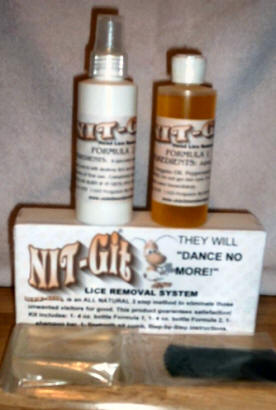
This has completed the treatment process. It may be necessary to use a “NIT COMB” to run through the strands of hair to eliminate any dead lice or nits. These combs can be purchased at most pharmacies. KIT INCLUDES….. 1- 4 oz. bottle FORMULA 1, 1- 4 oz. bottle FORMULA 2, 1- Shampoo Bar, 1- Nit Comb, Directions.
We are glad that you have chosen NIT-Git as your product of choice.
NIT-Git comes with a SATISFACTION GUARANTEE…if for any reason you are
unsatisfied with this product, simply return it to the manufacturer for
a refund. A small handling and shipping fee will be applied. |
Head Lice
(Pediculus capitis) are small, wingless insects about the size of a
sesame seed, found on the hair of humans. They live on the head and feed
by sucking blood from the scalp. The eggs (nits) of the female louse are
attached to the shaft of the hair by the saliva of the louse, a glue
like substance. The female louse can lay up to 100 eggs in her life
span. The eggs of head lice hatch in about 7 - 10 days. The lice then
grow for another 7 - 10 days before they are mature enough to reproduce.
The egg to egg cycle is about 3 weeks. How Common Are Head Lice? Head Lice are the most common insect infestation of humans. Outbreaks of Head Lice are common among children in schools, child care centers and other institutions. HEADLICE DOES NOT MEAN THAT YOU ARE AN UNCLEAN PERSON!! This is not the case at all. Just an unfortunate person like so many others around you who have gone through the same thing. How Are Head Lice Spread? Head Lice are spread by direct head to head contact with infested persons and sometimes by objects such as pillows, combs, hats etc., when the item is used immediately after use by an infested person. Head Lice can survive 48 hours away from a human host due to dehydration, because they can only replenish their water supply by feeding on human blood. Hence, the longer the lice are away from a human host, the weaker they become and the less likely they are to infect the next person. Head lice to not fly and can not be caught from animals. Head Lice do not live in furniture, bedding, carpets or clothes. Do not rely on scratching to be made aware of head lice infestation. A large percentage of infested persons do not suffer itching as a symptom. Are Head Lice A Health Concern? Bites from the lice may not affect infested persons initially but later can cause severe itching due to an allergic reaction to the saliva of the louse. Scratching the bites may give rise to secondary bacterial infections. Swelling of lymph nodes (adenopathy) in the neck can occur in some people due to this infection. Head lice are not a threat to health and do not transmit disease, they do however cause a lot of social distress and anxiety. |
Controlling
Infestation
Spread of the infestation can be controlled by adequate treating of
people who are infested, and by taking precautionary measures to
eliminate the lice.
* Avoid head to head contact with other persons, especially in schools, day care centers etc.
* Keep long hair tied back or in plaits, especially at school.
* Do not share hats, bike helmets, brushes, combs or pillows.
* Regularly check the hair of children who attend school or child care (twice weekly is recommended) by segmenting the hair with a fine tooth comb and carefully checking all of the hair and scalp.
* Wash pillow cases, towels and hats - of infected persons in hot water 55oC with a combination of Tea Tree 6 drops and Lemongrass 6 drops for 20 minutes and dry in the hot cycle of a drier or in the sun for a few hours.
* Hats and helmets that are not machine washable should be sprayed with FORMULA #2 then put in the sun for a few hours or stored at room temperature in a tightly sealed bag for 2 days. This length of time without a human host will eradicate the head lice.
* Treat all infested persons as soon as lice are detected.