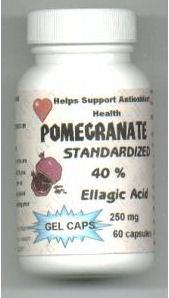
 POMEGRANATE
EXTRACT.... POMEGRANATE
EXTRACT....
mfg for and distributed by OTH
250 mg capsules
60 capsules per bottle
Recommended dosage..2 capsules a day
not to exceed 4 a day.
40% Ellagic
Acid
NOTE: THIS IS NOT
JUST GROUND UP DRIED POMEGRANATE...IT IS A STANDARDIZED
EXTRACT...200 MG from the seed AND 50 MG from the
fruit!!!!! THIS IS A TOP SHELF PRODUCT!!!!
DO YOURSELF A FAVOR...even if you do not make a
purchase, read the information provided below....IT JUST
MAY HELP YOU MAKE A CHANGE IN YOUR LIFE....
SATISFACTION GUARANTEED OR A FULL
REFUND!!!!!!!!!
Note: this product contains rice flour
What is Ellagic Acid?
-
Ellagic Acid is a naturally occurring polyphenolic constituent found in 46 different fruits
and nuts, like pomegranate, red raspberry, strawberry,
blueberry and walnuts.
-
Ellagic Acid is a nutraceutical.
-
Ellagic Acid contains a naturally
occurring phenolic compound that has very strong
anti-oxidant properties.
-
Ellagic Acid is also a potent
anti-carcinogen.
-
Ellagic Acid has the ability to
inhibit mutations within a cell's DNA.
-
Ellagic Acid is also considered to be
a cancer inhibitor which has the ability to cause
apoptosis or normal cell death in cancer cells.
-
In addition, research has found that
Ellagic Acid has antibacterial and anti-viral
properties.
-
Ellagic Acid may be one the most
potent ways to fight Cancer!
-
Ellagic Acid may be one the most
potent substances yet found to help prevent Cancer!
Simply put, clinical studies are
showing that Ellagic Acid may be one of the most potent
ways to prevent cancer, inhibit the growth of cancer
cells, and arrest the growth of cancer in subjects with
a genetic predisposition for the disease.
The Hollings Cancer Institute at the
University of South Carolina is conducting a double
blind study on a group of 500 cervical cancer patients
that has everyone excited. Nine years of study have
shown that a natural product called Ellagic Acid is
causing G-arrest within 48 hours (inhibiting and
stopping mitosis-cancer cell division), and apoptosis
(normal cell death) within 72 hours, for breast,
pancreas, esophageal, skin, colon and prostate cancer
cells.
Ellagic Acid has been demonstrated in
animal models to inhibit tumor growth caused by
carcinogens. Other studies have also found positive
effects. A recent animal study found that ellagic Acid
protected mice against chromosome damage from radiation
therapy. A separate study of ellagic Acid indicated that
it was effective at inhibiting tumor growth from
esophageal cancer cells in mice.
If we consider all the ramifications
of the current cancer pandemic and the dismal failure
rate of the traditional methods of treatment, then we
may start to realize that nutraceuticals, such as
Ellagic Acid, may hold the key to millions of successful
outcomes for cancer sufferers.
Pomegranate is a great source of
potassium, vitamin C and polyphenols, which promote
heart health. Pomegranates also contain high levels of
flavonoids, potent antioxidants, which may offer
protection against heart disease and cancer. A glass of
pomegranate juice has more antioxidants than do red
wine, green tea, cranberry juice and orange juice.
According to a study reported in the American Journal of
Clinical Nutrition, people who drank just 2 oz. a day
for a week showed an average increase of 9% in
antioxidant activity. And in a study presented at an
American Association for Cancer Research conference last
month, researchers found that pomegranate extract may
help fight skin cancer.
POMEGRANATE
EXTRACT 40%
The lovely and delicious pomegranate fruit reminds
us of the lush gardens of Andalucia, Spain. The name
comes from Pomme de Granada, "apple of Granada" it
was thought to have originated there. Granada's
coat-of-arms still displays the picture of this
exotic fruit. In ancient times, pomegranate fruit
was regarded as a symbol of fertility due to the
round shape, and abundant seeds. Recently however,
science has discovered important compounds, which
indicate its benefits, transcend ancient symbolism.
Pomegranate extract is primarily composed of
alkaloids and polyphenols. The active constituent
that appears to be responsible for its multiple
health benefits is Ellagic acid. Ellagic acid is a
naturally occurring phenolic compound found in
several fruits and nuts. Pomegranate extract has
demonstrated a variety of beneficial functions
including antioxidant and anti-viral activity. In
1996, a Nottingham, PA University research team
learned that pomegranate extract could destroy
several viruses nearly on contact. The discovery of
this anti-viral activity instigated further
experimentation and clinical trials. One study
confirmed that Ellagic acid effectively protects
cells from damaging free radicals. Additional
phenolic compounds found in pomegranate known as
anthocynadins (also well known scavengers of free
radicals) combine synergistically with Ellagic acid
to greatly augment pomegranate's potency as an
antioxidant.
Of great importance is the pomegranate extracts
potential use as a chemo-preventive agent. Initial
experimentation by Stoner and Mukhtar showed that
Ellagic acid decreased the number of chemically
induced lung tumors by 44-75%. Mukhtar further
illustrated that topical application of Ellagic acid
provided protection against chemically induced skin
tumors.
Ellagic acid has several mechanisms of actions by
which it exhibits its chemo-preventive properties.
Research by Barch et al. Demonstrated that Ellagic
acid could actually bind to DNA, thus preventing its
carcinogenic alteration. Additionally, Ellagic acid
has been shown to induce the production of phase 11
detoxification enzymes through its manipulation of
gene expression. With an increased concentration of
these enzymes, various tissues ability to detoxify
harmful compounds is augmented. Finally, Ellagic
acid was found to be a potent inhibitor of tyrosine
protein kinase, a molecule whose activity has been
associated with the ability of certain viruses to
transform normal cells into cancerous cells.
Science News
Pomegranate juice confers cardiovascular health
benefits
In vivo
studies in healthy nonsmoking men and mice with
experimentally induced atherosclerosis (hardening of
the arteries) concluded that pomegranate (Punica
granatum)
had potent antiatherogenic effects, possibly due its
antioxidant activity. In the men, consumption of
pomegranate decreased the susceptibility of
low-density lipoprotein (LDL) cholesterol to
aggregation and retention, and increased the
activity of serum paraoxonase (a naturally occurring
antioxidant) by 20%. In mice, pomegranate reduced
oxidation of LDL by 90%. In addition, pomegranate
shrank atherosclerotic lesions in the mice by 44%,
compared with control mice. Aviram M, Dornfeld L,
Rosenblat M, et al. Pomegranate consumption reduces
oxidative stress, atherogenic modifications to LDL,
and platelet aggregation: studies in humans and in
atherosclerotic apolipoprotein E-deficient mice.
The above information is not
intended to treat, diagnose, cure or prevent any
disease. If you are having serious problems,
consult your healthcare provider at once |